
Tree Planting
- littletreeblog

- Jul 28, 2021
- 2 min read
Plants play a vital role in human lives. However, recently, deforestation has been increasing as a result of agricultural croplands, mining activities, urbanization, etc. The loss of forests has caused flooding, soil erosion, greenhouse gases, and more consequences on our lives. Hence, this blog will discuss the positive effects that forests provide and the action of the WILD Outside Moncton team.
Benefits
It is undeniable that forests are beneficial to all living things. Here are a few common benefits of them:
Reduce carbon dioxide: trees absorb carbon dioxide and release oxygen during photosynthesis.
Reduce pollution: human activities can produce billion metric tons of carbon dioxide, particularly in urban or industrialized areas. For example, in 2015, roughly 40 billion metric tons of carbon dioxide were emitted by human activities, such as the burning of coals or fossil fuels, vehicles, cement production,... With that being said, the more carbon dioxide released, the more trees we need.
Mitigate the damage caused by flooding/droughts: regarding how trees reduce the damage of flooding, forests retain excess rainwater, and the roots of the trees absorb the water so it cannot flow away. By releasing water in the dry season, forests help diminish the severe effects of droughts. Another example is soil erosion. Trees reduce soil erosion by preventing wind and water from carrying away the topmost fertile layer of the soil easily.
Provide habitat for plants and animals: forests are home to more than three-quarters of the world's life on land. These ecosystems are complex webs of organisms that include plants, animals, fungi, and bacteria.
Maintain water quality: trees slow down the rain, helping it soak into the soil where substances (pollutants) are filtered out.
Take action
Therefore, to help tackle those issues mentioned above, last October, the WILD Outside Moncton team partnered with the Shediac Bay Watershed Association to plan a buffer of trees between a walking trail and a highway where the traffic is always busy. We planted over 60 native trees of the Acadian forest, such as red spruce, balsam fir, yellow birch,...
In May, we also did another tree planting event which was in partnership with the Fundy Biosphere. However, because the weather was unfavorable, we had to wrap up our event early.
You can do it, too! One simple activity you can do at home is creating a pollinator habitat in your backyard to attract bees, butterflies, beetles,... Here is a list of a few pollinator-friendly plants I have compiled:
Alyssa
Monarda
Salvia
Basil
Lavender
Calendula
Sunflower
Ninebark
Furthermore, to succeed, you should focus on other factors, such as sun exposure, size, layout,... Check out this link for additional tips and resources: https://xerces.org/pollinator-conservation/pollinator-friendly-plant-lists.
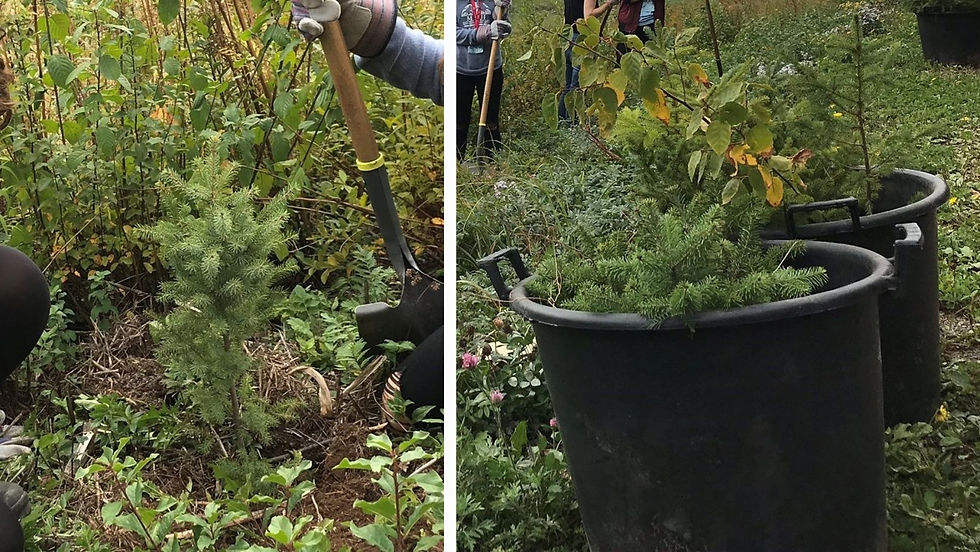
Although this project will not dramatically help solve climate change or global warming, it is still practical and meaningful because it does not only enhance the collaborative spirit within our team but also contributes to the community.
Works Cited
DeannaCat. (2020, April 27). Top 23 plants for Pollinators: Attract Bees, Butterflies, & Hummingbirds. Homestead and Chill. https://homesteadandchill.com/top-23-plants-for-pollinators/.
Forests can help prevent floods and droughts. European Environment Agency. (2020, November 23). https://www.eea.europa.eu/highlights/forests-can-help-prevent-floods.
Pollinator-Friendly Native Plant Lists. Xerces Society. (n.d.). https://xerces.org/pollinator-conservation/pollinator-friendly-plant-lists.
Scott, M., & Lindsey , R. (2016, June 15). Which emits more carbon DIOXIDE: Volcanoes or HUMAN activities? Climate.gov. https://www.climate.gov/news-features/climate-qa/which-emits-more-carbon-dioxide-volcanoes-or-human-activities.
World Wildlife Fund. (n.d.). Forest Habitat. WWF. https://www.worldwildlife.org/habitats/forest-habitat.



Comments